How Much Does a Website Cost in 2026?
Jakub Nalewajk · March 11, 2026
On this page
Some offer a site for $200, others for $50,000. The range is absurd and without context it means nothing. I break down what affects the price, how much different types of websites actually cost, and when it’s worth spending more.
Quick pricing overview for 2026
| Website type | Template/builder | Custom project |
|---|---|---|
| Business card site | $300 - $1,000 | $1,500 - $4,000 |
| Company website (multiple pages) | $800 - $2,000 | $2,000 - $8,000 |
| Landing page | $300 - $800 | $1,000 - $3,000 |
| Online store | $1,000 - $3,000 | $3,000 - $20,000 |
| Web app / custom system | - | $5,000 - $50,000+ |
Prices vary significantly by region. European and US markets differ.
What affects the price?
1. Type of website
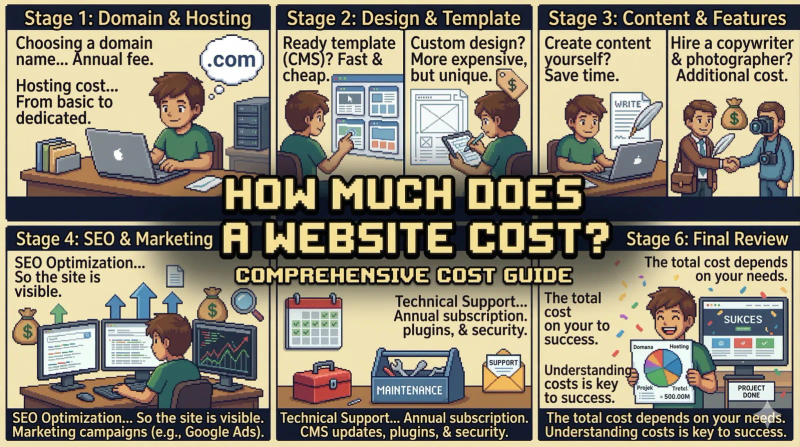
A simple business card site with 3-5 pages is completely different from a store with 500 products or an online booking system. More features means more work, which means a higher price.
2. Template vs custom design
A ready-made template (e.g. from WordPress) can be set up in a few days. A custom project takes weeks of design, coding, and optimization work. Templates are cheaper but limited. Custom projects give you full control over look and performance.
3. Who builds it - freelancer vs agency
This is one of the biggest price differences:
Freelancer:
- Typically $500 - $4,000 per website
- Direct communication, faster decisions
- Lower overhead costs
- Better choice for smaller projects
Agency:
- Typically $3,000 - $25,000+
- Team of specialists (designer, developer, copywriter, project manager)
- Formal processes, longer timelines
- Better for large, complex projects
For a typical small business - a hairdresser, mechanic, gardener, restaurant - a freelancer is usually the better choice. You pay less, get your site faster, and have direct contact with the person building it.
4. Additional features
Every extra feature adds cost:
- Admin panel (content editing) - usually included
- Contact form - usually included
- Booking system - from $800 extra
- Payment integration - from $600 extra
- Multi-language support - from $400 extra per language
- Animations and effects - from $200 extra
5. SEO and optimization
A good website isn’t just about looks. For customers to find you on Google, your site needs to be:
- Fast - loading time under 2-3 seconds
- Responsive - working on mobile just as well as desktop
- SEO-optimized - proper structure, meta tags, speed
Some developers include basic SEO in the price, others charge extra. Always ask.
Hidden costs nobody talks about
Building the site isn’t the only expense. You need to account for ongoing costs:
| Item | Annual cost |
|---|---|
| Domain | $10 - $30 |
| Hosting | $50 - $200 |
| SSL certificate (padlock) | $0 (free) - $50 |
| Maintenance and updates | $200 - $800 |
That’s $260 - $1,080 per year to keep your website running. Many developers don’t mention this upfront.
SSL certificates (the padlock next to your website address) are free in most cases today.
When is a cheap website a bad idea?
A $200-400 website sounds tempting, but consider:
- Will it be fast? Slow sites = fewer customers
- Will it rank on Google? Without SEO, nobody will find you
- Will it look professional? First impressions matter
- Can you easily edit it yourself?
- What if something breaks? Will the developer still be around?
A cheap website that brings no customers isn’t a saving - it’s wasted money.
When is it worth spending more?
Investing in a more expensive site makes sense when:
- The website is your main customer acquisition channel - e.g. a service business that lives off online inquiries
- You need to stand out - in competitive industries, a template won’t cut it
- You need specific features - booking system, price calculator, integrations with other systems
How to choose a developer?
- Check their portfolio - see what they’ve built before. Do the sites look good? Are they fast?
- Ask for a detailed quote - what exactly is included? What costs extra?
- Test their sites’ speed - enter a portfolio site URL into PageSpeed Insights. A score below 50 is a red flag
- Ask about post-launch support - what happens when you need changes in 3 months?
- Don’t pick the cheapest option - but don’t overpay either. A fair price for a solid business website is $1,500 - $4,000
Summary
How much does a website cost? It depends - but for a typical small business, a realistic budget is $1,500 - $4,000 for the site + about $300 per year for maintenance.
The most important thing is to choose a developer who:
- Shows you concrete examples of their work
- Gives you a clear quote with no hidden costs
- Cares about speed and Google visibility
- Doesn’t leave you alone after launch
Looking for someone to build your site? Check out my services or get in touch - first consultation is free.